
Your goal
Prepare the clothing, equipment and help needed for a first supervised visit. Begin with Comb and the working nest. This is preparation for learning with a beekeeper, not a complete hive-opening procedure.
Plan the visit before packing the bag
Agree who will guide you, what you will observe and when the visit should be postponed. A useful first objective is to recognise equipment and practise recording observations. Handling a colony can come later, when your instructor judges the conditions and your preparation suitable.
Make protection fit the task
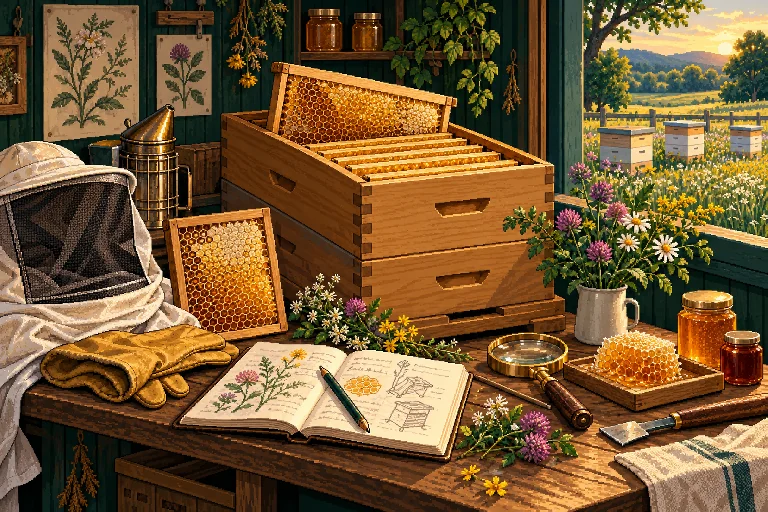
A veil protects the head and face; a suit or jacket, gloves and suitable footwear cover other exposed areas. Inspect the clothing for holes and gaps, particularly at closures, wrists and ankles. Put it on before approaching the hives and move away from the apiary before removing it. Protective clothing reduces exposure; it cannot promise that you will never be stung.
Ask your instructor to check the fit while you bend, reach and move your hands. An outfit that looks closed while you stand still may expose a gap during work.
Understand what each item is for
| Item | Role in a beginner visit | Question to ask |
|---|---|---|
| Protective clothing | Reduce exposure to bees | Does it fit and remain closed when I move? |
| Hive tool | Help separate hive parts | Which surfaces may I work against without damage? |
| Smoker | A colony-handling aid requiring training | Who is responsible for its use and fire precautions? |
| Notebook or recording sheet | Keep observations separate from guesses | What question are we trying to answer? |
| Communication and first-aid arrangements | Make help accessible | How will we explain our location? |
A smoker is also a hot object and an ignition source. Learn its use in person, including extinguishing it, and check local fire restrictions. Do not copy another country's fire rules as though they apply at your apiary.
Prepare for stings without improvising treatment
Discuss a known or suspected sting allergy with a healthcare professional before working with bees. Plan your first visits with another person present. Know how to summon help and have the actual apiary location available.
Sweden: 1177 advises calling 112 immediately for breathing difficulty or feeling faint after an insect sting. Follow your prescribed emergency plan if you have one. For non-emergency health advice, use 1177. Elsewhere, identify the local emergency number and healthcare guidance before the visit.
Practice: the five-minute briefing
Prepare answers for your instructor:
- What do I want to learn today?
- Which equipment have I checked, and what remains uncertain?
- Who handles the smoker and heavier equipment?
- How do we get help and describe this location?
- What would make us stop or postpone?
This briefing is a learning exercise. It is not a certificate of readiness or a substitute for the instructor's judgement.
Check your understanding
- Does owning a bee suit mean you are ready to open a hive? No. Fit, conditions, handling knowledge and support still matter.
- Can a smoker be packed away while hot? Do not treat a hot smoker as ordinary luggage; learn safe extinguishing and handling before use.
- Why write the location down beforehand? It helps you communicate clearly if help is needed.
- Should you memorise a foreign emergency number? Use the number and guidance for the place where you are working.
Continue
Next: Biosecurity before the hive visit, then Plan a purposeful colony inspection.
Sources and applicability
- Agriculture Victoria: Safe beekeeping practices — general protective-clothing, support and smoker principles; Australian legal details are not adopted here.
- University of Delaware / MAAREC: Beekeeping equipment — equipment functions.
- 1177: Insect allergy — Swedish emergency advice.
Sources checked 2026-10-30. Introductory preparation lesson; emergency details are explicitly labelled for Sweden.